Thursday, November 26, 2009

On to Bigger and Better Things (like 1st Grade)

Carey's preschool just celebrated their first ever graduation! Eighteen students from the Susanna Wesley Preschool graduated at a very special ceremony held recently in Camanchaj. Decked out in robes and homemade construction paper hats with tassels, the students received their "diplomas" from a very proud Directora.

One of our honor students, Jennifer Karina, looking ready for first grade, which she'll start in February at the Camanchaj public school.

The parents presented a special gift to the preschool, which will hang outside of the classroom for years to come as a reminder of our first graduating class.

Karla Alessandra and mother, Kristina, one of our lab techs, pose for a picture after graduation. Carey printed family photos on the spot with a printer donated by one of our medical teams. The families were thrilled!

Our last day of school! Carey and preschool teachers, Mary and Paulina, will miss this great group of students dearly, but they are so proud of all they have accomplished this past year...

Happy Thanksgiving!
May each of you continue to be blessed with health, peace, and most importantly, friends and family that love and care for you.
Dios Les Bengida,
Jay & Carey

Thursday, November 19, 2009

Stick a Fork in Me...

I just finished hosting our 22nd and last mission team for 2009, and although I'm super tired I also feel super fulfilled.
22 Teams
320 Volunteers
Thousands of patients (medical and dental)
Hundreds of surgeries
7 Construction projects completed
2 Tired but very blessed gringos living in Guatemala

Our vision teams hand out a standard-sized round frame to all vision patients. If you look closely you can see that the glasses look exactly like Harry Potter's glasses. The week after clinics half the town has turned into wizards : )

I had hundreds of pairs of old-school sunglasses to hand out in San Jorge La Laguna. You would have thought I was handing out pieces of gold. I got swarmed handing out relics from Michael Jackson's closet.

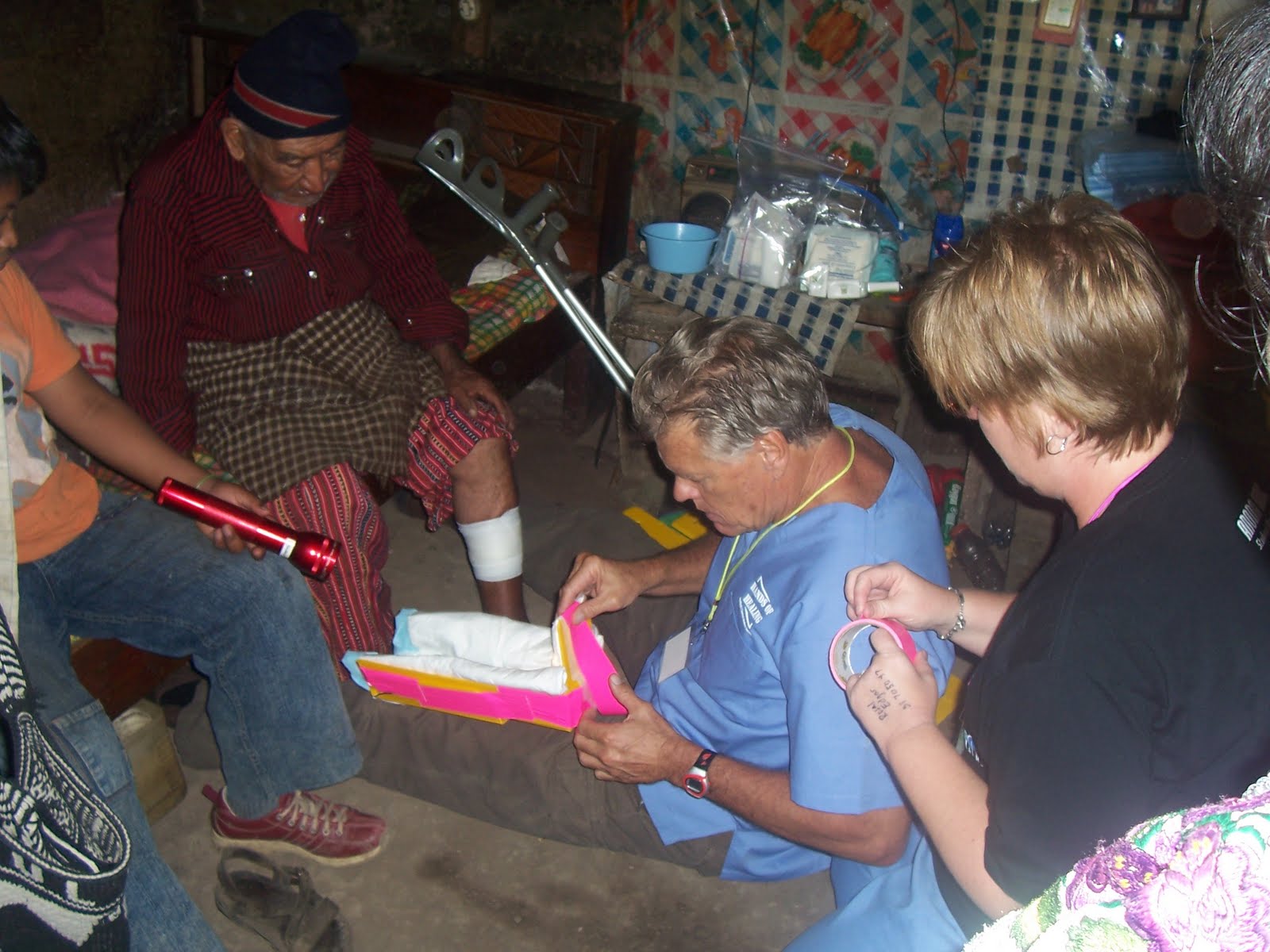
Our docs made a home visit and pulled a MacGyver: they made a leg splint for a man with a fractured leg out of Maxi-Pads and an old cardboard box. Sweeeet.

The kids at El Barranco performed a traditional Mayan dance for us to thank our volunteers for their service. It kind of looks like they're making an offering to my backpack, which sits in the window behind them.

How can we say thanks?
Carey and I will be in the States (Texas) this December to visit family and friends for Christmas and make several presentations at local churches for Salud y Paz. It will be a great time of rest for us before we return in January for six more months of service.
As we approach Thanksgiving, Carey and I feel eternally grateful for all of your love and support. We hope to see many of you soon and give you a big hug from the people of Guatemala!
Peace to you!
Love,
Jay & Carey

Wednesday, November 11, 2009

You Are What You Wear

Imagine if everyone in the city of Houston wore red shirts and everyone in Austin wore blue shirts. That's what Guatemala is like. When the Spanish came to Guatemala in the 16th century they had each village wear a different color "traje," a traditional dress/suit, so they could identify where someone was from. That tradition has managed to survive through today, making Guatemala one of the most colorful and tradition-rich countries in the world.

These women are from Santa Catarina, a village about 5 km up the road from Carey and me. They are easily identified by their turquoise traje and blue or purple head dress. Most all indigenous Mayan women and their daughters continue to wear traditional traje today.

It's becoming less common for Mayan men to wear traje, mainly because the suits are relatively expensive and they are worn out too fast while working in the fields. This man is likely from Solola, 20 minutes from Pana. It's a pretty cool look, despite the fact that the length of his pants make him look like he's waiting for a flood : )

The traje is made using two very old methods: 1) backstrap and 2) wooden loom. Mayan women are responsible for the huipil, the blouse, or top part of the traje, and the Mayan men (usually younger boys) work to create the dress, or bottom part of the traje.

Here you can see a woman making the huipil using the backstrap weaving. It appears to be a pain-staking, uncomfortable way to weave, but the end product is beautiful and can sell for about Q800, or $100. Women wear the huipil of their village everyday and it will last them several years.

The looming process that the men use to create the corte (dress) is very different. They start with these foot long threads......next they use this old-school method to spin the thread onto small spools...

...finally the young men take the spools and toss them back and forth through the loom for the final product...
Check out this video to see how it's done. These guys work 10 hours a day, 6 days a week. It takes them 3 full days, 30 hours, to make one corte/dress. For this work they'll receive around $3-$4/day, assuming they can sell two cortes a week. Believe it or not this is pretty good pay.

This little cutie was kind enough to pose for me to show the finished product. The corte comes out of the loom in one 10-15 foot piece. You can see how this corte has been sewn together from two different pieces (top and bottom). These cortes cost around $50 each.

A quick word on donating clothes as an American: Chances are if you've ever donated clothes into one of those big metal bins in a parking lot they're ending up in Guatemala or other developing nation. These American castoffs are sold to the locals here for super cheap. The beneift is that they provide people with a good, cheap option for clothes. The downside is that the clothes are so cheap that less and less people are wearing their traditional traje, thus losing an important aspect of their culture. It seems that no issue today is as black and white as we would like it to be.

Thanks for checking in! We look forward to seeing many of you in December when we're home in Texas!

Love, J & C

Saturday, October 17, 2009

Goofy Gringos & Machismo Men

If you ever visit Guatemala you will likely notice 3 things about the people:
1. Machismo Men
I have heard this exact story on at least twenty different occasions from women: "I've got to work so hard because my husband drinks too much and can't find work. Also, I can't care for my 7 kids alone since my husband left me for another woman." Stereotypes aside, it's clear that machismo is alive and well in Guatemala. Machismo is basically when men act like they're better than women and entitled to do whatever they wish, including sleeping around once they're married and drinking away the family's income. It's really despicable to see - fortunately not many men leer at Carey since she's usually with me (we've found that the Mayan men exhibit less machismo than the Ladino's - Mayan/Spanish mix).
2. Wonderful Women
When you've got so many men dropping the ball on their responsibilities - you've also got a lot of women really stepping up and impressing. I have met some of the most incredible, strong-willed, family-focused, hard-working women of my life in Guatemala. It's really something to see a woman walking with one infant strapped to the front of her body and probably 30 pounds of wood or goods for sale balancing on her head as she heads to the market each day. It's almost sad that many of them don't complain more - I guess they know what they've got to do and they do it. The real heads of the household.
3. Goofy Gringos
It's official, any white person who lives in Guatemala for several years loses all of their social skills and becomes like one of those people who've watched too many Star-Trek episodes. This country seems to be a magnet for second-generation hippies and social misfits. It's difficult to say whether they were like this when they moved here or if they became this way after too much time here. At first I thought we were the only ones noticing it, but then a few Guatemalans confirmed it for us.
So, if Carey and I come back goofy and socially awkward, please smack us. Just in case we were already infected though...I'm working on an antidote ; )

Hook 'em Horns!
Jay

Friday, October 9, 2009

God Loves You...now MOVE IT!

I am not a good driver, which means that I fit in very well in Guatemala. In fact, being unsafe and overly aggressive actually has served me well while driving here in this country. When I first took to the roads over one year ago, I was petrified. Now, however, I'm convinced that anyone can drive here - all you have to do is follow a few simple rules...
Respect the Hierarchy!
You will survive the mean-streets of Guatemala if you yield to vehicles in the following order:
1. School Bus (known as a "Chicken Bus" by most) - Hi, Satan taught me to drive. Don't ever look me directly in the grill. Don't ever try to pass me. Don't think I won't run you off the road to pick-up one more 10-cent fare. I rule these roads - the sooner you learn that the better. Watch for me in your nightmares.
Most of my friends paint "God Loves You" on the front of their windows. And I'll help get you to God sooner than you expected!

2. Dump Truck - Hi, I'm bigger than the Bus but I know my place. Beware of me backing up into you and creating huge traffic jams in small towns!
3. Toyota Pick-up - Hi, I may be stuffed with 22 Mayans, but my mighty V-6 engine won't quit. Remember, on the 8th day God created the Toyota. Don't get too comfortable - I'll be swinging wide around that tight corner right ahead of you!
A light load for me.
4. Gringo in early 1980's Car - Hi, I really have no idea what I'm doing, but I've got the Embassy on my side! I will blind you with the glare bouncing off of my white forehead. Watch for me going the wrong-way on a one-way street.
5. Tuc-tuc - Hi, I may be small and run on a lawn-mower engine, but we swarm pueblos like angry bees. And yes, my 13 year-old driver will take that turn on two wheels! Don't step out into that street too fast - I'll be there!
There are 150 Tuc-tuc's (named after a small animal) in Pana - many of us are super "pimped" out with lights and flashy painting.
Remember: You have NO rights as a pedestrian.
As American's we assume crossing a busy intersection is our God-given right. If you follow that logic here you'll be road kill quick. In Guatemala, you have zero rights when crossing a street. A chicken bus driver will run you down without a second thought, stop to urinate on the side of the road, and then go home and put another notch in his bedframe.
When stopped by the police, play DUMB!
Works everytime. Tell them you didn't know you needed a Guatemala drivers-license. Tell them you're lost. Tell them you're here to de-worm orphans. Just don't tell them anything in Spanish!
Congratulations! You're now "road-ready" for Guatemala.
Oh yeah, one last thing before getting on those roads...pray!
Peace ; )
Jay

Wednesday, September 30, 2009

Pray for Rain

When 50% of your country's children already suffer from malnutrition and there's a drought during what is supposed to be the rainy season, you've got a disaster on your hands. And that's exactly what's happening now in Guatemala.
The United Nations is reporting that Guatemala is suffering from their worst drought in 30 years, with up to 70% of their crops destroyed. This has led Guatemala's President to request international aid to help the 2.5 million affected indigenous Mayans.


Carey and I had been told that it would pretty much rain here every day May through October, so we knew something was up when it didn't rain hardly at all for the past three months. It's finally started raining periodically, but it may be too little too late (the "rainy" season ends in one month). If it is, Guatemala may be in serious trouble.


The Ugly Facts:
- 75% of Guatemalans live below the poverty line (World Bank)
- 58% of them in extreme poverty (meaning they can't buy basic foods day-to-day)
- Guatemala has the 4th highest rate of malnutrition in the world (and highest in Latin America)
- 200,000 Guatemalans were killed during their 36 year Civil War (1960-1996)
- 30% of pregnant women are malnourished
- Poverty level in Quiche (where Carey and I work) is 80%


The extreme malnutrition in Guatemala is being blamed on: 1) price of eggs and beans has risen over the last few years (best source of protein for the indigenous), 2) no clean water = severe diarrhea, 3) lasting effects of the civil war, 4) the government can't help due to low tax revenue, and 5) cycle of poverty within families with too many children to feed.


How to Help:
1. Pray for people to respond to tragedies like this with generous hearts.
2. Read the book, "The Life You Can Save," by Peter Singer. I've read it twice and I promise it will rock your world. I'll never spend my money the same or feel apathetic again toward world issues. $15 on Amazon.
3. Donate. You and I are very powerful people. All we have to do is take a piece of plastic out of our wallet and type on a keyboard. It feels good to save a life.
Some charities that are highly rated and helping with the crisis in Guatemala: http://www.unicef.com/; http://www.savethechildren.com/; http://www.oxfam.org/; http://www.wfp.org/countries/guatemala (United Nations). *Note: not all of these organizations guarantee that the money goes directly to those in Guatemala, but generally "where most needed," which in part will be Guatemala. Go to http://www.charitynavigator.org/ to research your favorite charities or those listed above.

Have a blessed week and thanks for checking in.
Love,
Jay & Carey

Wednesday, September 16, 2009

Feliz Dia de Independencia!

I think Guatemaltecos may cherish their freedom even more than Americans. September 15th is Independence Day in Guatemala, and it is a BIG deal. The party starts the night before with fireworks (the kind of bombs that are illegal in the States), streets packed with "torch-runners," and bratty little kids (and some adults) throwing water on said torch-runners. The celebratory atmosphere carries over into early Independence Day where all schools close to participate in the village parades.
Carey's school got to walk in the parade with the local Camanchaj school, and it was certainly a sight to see...
Each grade gets to have a "float." Think Rose Parade without roses and a very limited budget. And of course in Guatemala a TOYOTA truck is always there to help out.

The preschool's theme this year was Payasos (clowns!)

The dad's stepped up big-time to help with the float and the face-painting.

This is either super-cute or super-scary. KISS rocks!
I've heard of clown cars, but...

Each grade elects a "princess." Our princess was Jade and she got the first-class Toyota treatment for the parade.

In all their glory!
The proud Director with her minions ; )
In other news... "I really shouldn't have gone in there!"
I'm hosting a big surgery team from Colorado this week, and I've learned and seen things that few people should see. I saw a tubal ligation performed - very cool. But I also saw something called a prolapsed uterus - disturbing. In short, and I had no idea this was possible with the human body, it's when a woman's uterus comes outside of her body. I immediately regretted going into the operating room, but maybe it will make for interesting sermon material one day!
Peace,
Jay

Friday, September 11, 2009

Spending Your Money

Chances are if you're reading this, you may have donated some money to Carey and me. For this, we will be forever grateful.
I must admit, however, though we've gladly accepted your money, it hasn't always been easy for us to spend it. The first few months we were here in Guatemala were sheer torture. And it wasn't due to the culture shock or the upset stomachs, it was because of the guilt Carey and I felt for spending your money.
Here's the deal: when you're a 34 year-old man the last thing you want to be doing is mooching off of others (or worse yet, living with your parents while mooching off others, which we did for 2 months before coming here - geez!) You want to feel financially independent! You want to feel like your career and earnings trajectory is headed upward, not come to an abrupt halt! Yet here we were - no paychecks - reduced to sending out letters to ask for money.
When we first arrived in Guatemala, we were hyper-sensitive to how we spent your money. For example, it was three months before I would even buy a snack (something I considered a "non-essential" to our mission here). Over time, however, we've lightened up a bit, which we hope is okay with you. We're still pretty cheap when it comes to handing over our Quetzales, but we've recently discovered an unexpected blessing from spending someone else's money: it's made us extremely generous people.
What I mean by that is before, when I considered it "my" money, I was slower to give it away to people who needed it more than I did. Now, I find myself looking for opportunities to use "your" money to help others. And here in Guatemala, you don't have to look far. When one of my neighbors tells me they need medicine, I walk to the pharmacy with them and buy it for them. When we see a child with a need (milk, lunch) we but it for them. When we hear of a worthy cause to donate to (shoes for children, water purification systems), we give money towards the project.
By giving us your money, you have changed me. You give us your hard-earned money in order that that money would bless others. And it has. Thanks to your faith in us, I now see money differently. When I return to the States next year, and am receiving paychecks once again, I will see "my" money differently. In fact, I will no longer see it as "my" money. It's money given to me (I believe by God) to bless others. I will continue to be generous with money, because, in reality, it never really was mine in the first place.
So thank you for your trust, and thank you most of all for changing me.
Guatemaltecos use Quetzales for currency. A quetzal is the national bird here (see it in the upper left corner of the bill?) Q100 is the largest bill here, and is worth only $12 USD. When I go into a bank to get money for our teams (usually around $2-3,000 USD, I emerge looking like a drug dealer b/c of the huge pile of quetzales they give me. Nothing screams, "rob me!" quite like a gringo carrying Q24,000!
The Relative Cost of Things:
Here's how much we spend on common things here in Guatemala:
Rent: $230 (includes bills)
5-gallon jug of pure water: $2
Gas: approx. $2.70/gallon
Breakfast at a restaurant: $2.50
Head of broccoli, 2 carrots, 1 onion, 4 squash, avocado & bag of rice: $2 total!
Jar of peanut-butter: $9 !!! (we have teams bring it to us)
Dozen roses: $2
New pair of tennis shoes: $22
1-hour Spanish lesson (one-on-one): $5
"New" shirt: $1.50
Bus ride to nearest town: $.75
Each of these prices is about 30% higher for gringos - we get a "special" price! ; )
Have a blessed week!
Peace,
Jay

Friday, September 4, 2009

Websitemala

We just upgraded our old Salud y Paz website and had a professional video done to promote the work we do here in Guatemala.

*Check out the 8 minute video on YouTube (Carey's a star in it): http://www.youtube.com/watch?v=Kfm8T-41bBQ.

*Check out the new website at www.saludypaz.org.
Click on the 'About' tab and 'Meet our Staff' to see pics of the people we work with.

Have a great Labor Day weekend (and Hook 'em Horns!)
Peace,
Jay

Sunday, August 30, 2009

What It Means To Be A Missionary

I am a missionary. I haven't always claimed that title/role, though. That's because Christian missionaries from America have had a dubious history, to say the least. I believe that now, however, all that is changing.
What is a missionary? A missionary is:
1. someone who attempts to convert others to a particular doctrine or program.
2. someone sent on a mission--especially a religious or charitable mission to a foreign country.
For most of the 19th century it seems, Christian missionaries were mostly (solely?) interested in definition #1. Their mission was to "save" Africans, Latinos, Asians and Europeans by pressing them to convert to the Christian faith. They believed that these foreign peoples spiritual needs (salvation) were greater than their physical needs (food, shelter, etc.). At their best, they lovingly shared the good news of Jesus Christ with people who had never heard of him, and in fact, many people did come to faith in God because of their work. But at their worst, oh boy, where do I even begin? How about a list:
1. Missionaries made the foolish assumption that spiritual needs are more important than physical needs. "Feed their soul, THEN feed their stomachs," we said. Google: Maslow's Hierarchy of Needs to see otherwise.
2. Missionaries naively assumed that African villager X, even though he was raised his entire life to believe (fill in the blank), that he would/should promptly change all of his beliefs and accept Jesus as his personal savior. Oh yeah, and if he didn't he was a heathen destined for hell. Not cool.
3. Missionaries (again, not all, but many) believed that the "rest of the world" (read: uncivilized cultures) should be LIKE US (read: Americans). This one for me is the most unfortunate. Instead of learning from foreign cultures and peoples and being changed by them, we tried to change them to be like us. Que Lastima.

Let me be clear about one thing though: I am living in Guatemala because of Jesus. I'm crazy about the guy and I want to share his love and teachings with others. He's my life and my reason for being. I believe he has sent me (and all of us who choose to follow him) on a mission. My mission in Guatemala is to serve the people of Guatemala by helping to provide for some of their most basic needs (health care, nutrition, education), pray for patients and share my faith in Christ (when appropriate), and be utterly changed and shaped by this beautiful country and people - a country and people that God loves just as much as he loves the United States and the American people. That is my mission. I am a missionary.
And believe it or not, so are you.

Peace,
Jay

Wednesday, August 12, 2009

Welcome to the Jungle

In many ways I'm not very well-suited for this job. I'm a people-pleaser, which doesn't exactly work when you have 100 patient forms to give to 250 patients.
This happened practically every day last week while I was hosting our ninth and last team of the summer in Cunen, our most remote clinic. Here's the deal: it's my job to run the clinic. By the time our team of docs, nurses, pharmacists, and helpers arrives at our rural sites by 8 a.m., we've got a line of around 50 people. No problem, I think. On many occasions, however, that number swells to 150 people before lunch. Just to keep everyone's adrenaline flowing, after school gets out and I've already handed out all of our patient forms for the day, we're faced with around 50-100 more "late-comers." This is when the negotiating starts.
I have to protect my doctors and team, who have told me they can see around 100 patients max/day. So it's basically my job to turn-away 50-100 sick Mayans (including children). But they don't leave without a fight. And I don't blame them. This is their only chance for maybe a year to get some adequate health care and meds. So I tell them as nicely as I can that I am SOOOOO sorry, but we simply don't have time to see them. Some take the news in stride, others aren't so kind. I try not to take it personally. They're desperate. This is what breaks my heart and makes me feel like a big jerk.
Ugh. It's like a kick in the stomach.

Chiul - one of the rural communities around Cunen. It was a zoo. One of my doctors called me a "slave-driver." Lesson learned: we need reinforcements.

We just completed the construction on our newest clinic here in Cunen (about 5 hours north of where we live in Pana). We don't have a doctor yet, but once we've got the money we hope to start getting some regular care to this remote village.

One of the highlights of the trip was that my friend and our team driver, Pedro, let me drive his "chicken-bus." It's a 15-gear monster, and it defeated me handily. I think a few of my passengers lost their bowels when I hit a speed-bump going way too fast. They found the transmission somewhere in Albuquerque.


Muchas Gracias Steffie!
A big "thanks" to our good friend Steffie, who was kind enough to spend 5-weeks with Carey and me in Guatemala. Her work/vacation visit really lifted our spirits. We also got to celebrate Steffie's new job while she was in town. Thanks chica!


Introducing...Sabrina
Carey got another gift recently when her new preschool assistant teacher, Sabrina, arrived from Germany. Sabrina will be working with Carey and the kids for one year!

Carey and I hope you're all doing well and enjoying your summers!
Love,
Jay

Wednesday, July 29, 2009

Time to Get Earthy

What do you get when you combine an 8 foot deep hole, 20 Texas teenagers, and an "earthy" smell? A new septic system for our clinic in Camanchaj, of course.
Up until last week, our old "septic system" consisted of about 6 very deep holes scattered around the clinic. Well, as you may remember, we finally ran out of space in those holes a week after the preschool opened last January (picture this: "Yeah kids!!! Welcome to preschool. Just a quick note before we start learning, please don't play in the human waste. Not pretty). Anyway, with lots of hard work and generous donations from churches in the States, we've now installed a brand-new Water/Waste Treatment System (they don't like for me to call it a septic system, which of course it is.)
What started as nothing more than another hole on clinic grounds...


...became a fully-functioning Water/Waste Treatment System!


Now somebody go flush a toilet and let's see if this thing works.

While the youth did all the grunt work (yes, we did bust one of the septic lines while digging - dinner's on!), the adult chaperones got freaky with the preschool kids.
The thing that got us in this mess (pun intended) in the first place, was the fact that not many of our Mayan patients at the clinic know how to properly use a toilet. How would you if you didn't grow up using one or have one at home? Needless to say, a lot of "foreign objects," including newspaper and other items get flushed down our commodes. Thanks to some artsy Texas teens, we tried to educate the public (see above.)

Here's the proud artist next to her "community education" paintings. Beware, #2 is kind of graphic.
I never thought I'd say this, but it's a huge blessing to be able to flush a toilet without fear.
God Bless Texas!
Peace,
Jay

Friday, July 17, 2009

Vigilante Justice


We had some big news in our little town early this week when a "mob" of people torched the car of some suspected kidnappers. As I was walking to the market yesterday I saw a burned up car sitting in the middle of the road. I thought nothing of it (hey, this IS Guatemala), until I saw that same car on the front page of one of our national newspapers the following day (I use "news" loosely when referring to the Diario, which is more like the National Enquirer than the New York Times).
Here's the scoop as far as I can tell: 4 young men tried to rob and kidnap a local chicken vendor. Fortunately for them, they were caught doing this by the Panajachel police and not the locals of Panajachel. I say fortunately because if the locals would have caught the men, what's left of them would likely be sitting charred in their car, which was set on fire soon after the police left the scene. Quite a lot of drama for Pana in one day!
I don't want to make any broad generalizations here, but there are times in Guatemala when locals, especially in the smaller villages, choose to take justice into their own hands. It seems that many Guatemalans do not trust that the authorities will handle matters properly when it comes to crime. On this day, the bad-guys car was just torched, but earlier this year, in the village where we work (Camanchaj), a couple of thieves were caught, beaten, and burned to death. On the upside, there's not much crime in the smaller villages, as you can imagine. However, one could also raise a pretty strong argument against such swift justice, especially when the suspects turn out to be innocent, as I'm sure has been the case on more than one occasion.
Not that I think any of this matters to the Diario, who I think is just happy to put another burning car or bloody body on the front of their paper...
UPDATE...
I just found out today (Saturday) from my friend in town that the car the locals burned up was actually the car of the man who was kidnapped! Doh! Talk about a goof-up in vigilante "justice." Oh well, we in Pana never claimed to be the brightest people, we just live in the most beautiful place. : )
Peace,
Jay

Wednesday, July 8, 2009

The Widowmaker

In honor of the late, great pitchman Billy Mays, let me introduce you to a product even he would have a hard time selling...
It's an absolute breakthrough of modern technology and ingenuity! You won't find it in your local Bed, Bath and Beyond, no sir, this baby can only be purchased in the finest developing nations. It's the electric showerhead!! Now I know what you're thinking, "Billy, why would someone mix electricity and water? Didn't mom always say to not bring a toaster with us into the tub?" Yes, but this little water-warming friend is different! As long as you very carefully avoid touching any of the exposed wires or metal parts, electricity won't pass through your body as you stand in 2" of water! It's genius! And what's best is if you call now, I'll throw in our newest product, the diesel-powered toilet! You'll never be constipated again! You get all of this for only 5 easy payments of $19.95!!!

The gringos here call it the "widowmaker." Carey and I just moved into a smaller place to save money, and we're lucky enough to have one. Notice the exposed wires and strange antenna on the side (what the heck is that thing for?) Day one in shower: I reach up to change the setting and get the shock of my life. Needless to say, I let slip a few non-approved words for missionaries.

In other news...
As medical team coordinator, I'm often put in the situation of having to ask dumb questions of my team leaders like, "What's the difference between a vaginal speculum and a vaginal specula?" (one is just the plural of the other. Duh, Jay). One thing I love about this job though is the creativity of the doctors we bring down. Last week I told one of our docs that we don't have any ring forceps for him to use when he is giving gynecological exams to our female patients. He says, in true rural clinic fashion, "Don't worry, I'll just use disposable chopsticks and rubber bands."
I'll let your imagination take it from there... ; )
Peace,
Jay

Friday, June 26, 2009

MINORITY REPORT

As a white, middle/upper-middle class American man, there have been very few times in my life when I have not been in the majority or in a position of "power." I first started to realize this when a college professor of mine did a little experiment in class one day to help us understand what it felt like to be the minority. She asked everyone who wasn't white, conservative, heterosexual or male to go stand on one side of the room. Moments later, I realized I was the only one left at their desk. Although it was an uncomfortable feeling, it only lasted until the class ended.

Today I live in Guatemala, where I am, for the first time in my life, truly "the minority." It's a strange feeling to walk through a village and be the only white person, the only one in Western clothing, the only one with a high school degree. The reaction has been mixed. In some places, Guatemaltecos are used to foreigners and think nothing of my presence, but at other times, in smaller, more remote areas of the country, the people have stared at me like I'm an alien. I guess it's possible that they've never seen a white man before, at least not one in person.

Despite being the minority wherever I go, I don't believe I'll ever truly know what it means to be a minority. I say this because most minorities in the world share one thing in common: they have little to no power. As an educated American man, however, that's not true for me. Even though I am often frustrated by my inability to fluently speak or understand the Spanish language, I am STILL in a position of power here:
- People often assume I'm a doctor even though I don't know the first thing about medicine.
- I have more money than just about everyone I've ever met here.
- I'm assumed to be a "boss" because of my color, education, and position.
Contrast my experience here in Guatemala to a Mexican immigrant (legal or illegal) in the United States. He or she has little to no power, they are rarely assumed to be the boss, and they are publicly disrespected if they can't speak English fluently (whereas I'm patted on the back for being able to speak Spanish at the level of a 1st grader). I have felt great embarrassment on several occasions when one of our volunteer teams from the States come into this country like they "own the place." This doesn't happen very often, but I can't imagine a Latin immigrant coming into the U.S. and acting like that! Only the "powerful" can act in such a way.

I think it's important to experience being "the minority" at some point in our lives, if only in some small way. This experience has helped me understand the great responsibilty I have as an American citizen in a foreign country, and also to be more aware of the minority and those without power in my midst. In many ways I think the best measure of a society/person is how it/we treat the powerless minorities in our midst.

GRINGO?
I have been called a "gringo" many times in Guatemala. I don't take offense to it. It's nothing like the "n..." word for African-Americans. It's basically come to mean any person from the United States (or an European who is mistaken for an American.)
I always was told that the term developed during the Mexican-American War, when the Mexicans would cry out to the uniformed American soldiers, "green go," meaning "leave our country." But it turns out that the Americans actually wore blue uniforms during this war, so it probably came from the Spanish word, "griego," which means "greek." Or I could be wrong. It's all greek to me.

Peace,
Jay

Friday, June 19, 2009

Street Life is Ruff

Panajachel has a perro problem. There are wild dogs everywhere in Guatemala. Most people here do not consider dogs pets, nor are there resources available to prevent strays from multiplying rapidly. Sadly, the only thing that has prevented them from multiplying faster is that many of them starve to death.
Until now, Carey and I have resisted the urge to adopt one of these pups. Recently, however, we found an organization (Mayan Families) in the town where we live that gives out free, already spayed/neutered and vaccinated dogs to good homes. So...we brought home a very rare breed called the Panajachel Street Terrier (as my father-in-law calls her, without the slightest hint of sarcasm) on Monday. This came about because a) I am away from home a lot traveling with teams, b) Carey doesn't like being home alone (I don't blame her), c) Carey is very convincing, and d) Carey's mom, Linda, and stepdad, Tom (who's like the Dog Whisperer), are visiting and can help train her.
She was found a few months ago on the streets looking starved and scared. We have her right now on a "trial basis," but are hopeful that it will work out. Her name is Ati, after the lake we live on, Lake Atitlan.

By the way, the director of Mayan Families says that they are in desperate need of donations for spaying/neutering (the procedure costs about $20). If you are interested, you can make an online donation through their website (http://www.mayanfamilies.org/) or search for them on Facebook. Be sure to designate the donation for animal welfare. And even if you don't make a donation, check out all the incredible work this organization is doing for Guatemalan families (both human and canine)! Salud y Paz often collaborates with them to find patients and rural towns in need of doctors/dentists.

Be Happy You've Got Yours
I blame Coke. Many rural Guatemalans have lost quite a few of their teeth. When they come into one of our dental clinics for some work, you can see where the soda has literally eaten a whole through the front 2 teeth. Our dentists do what they can for them, which usually means pulling 2-4 teeth. The Salud y Paz record so far for teeth pulled on one patient is 11. Ouch.This denture is called a "placa." They are very common in Guatemala. Once your front 4 teeth have rotted out, you go to a little store to get your placa made. It's popular to get fake gold teeth and stars on the false teeth. It's very strange to see a 16 year-old girl take out her dentures, but I see it a lot. In the picture above, a woman came in with severe ulcers in her mouth b/c her placa was rubbing her gumline. In true rural clinic fashion, we took a metal file and filed down the placa to make it fit. Another happy customer!

Carey and I hope you and your families are well.
Love,
Jay

Sunday, June 14, 2009

Bad Religion?

Last year I read a couple of the top-selling, so-called "Atheist Manifesto" books: The God Delusion, by Richard Dawkins, and Letter to a Christian Nation, by Sam Harris. I read them because I'm interested in why someone would choose to be an Atheist, and also because I want to know what the current arguments are against Christianity and belief in general so I can see how my faith stands up.
Atheists used to argue that belief in (a) God/god was simply irrational, but today their argument has changed somewhat. Now many Atheists such as Dawkins, Harris, and Christopher Hitchens (god is NOT Great) are taking a new approach. The argument today goes something like this: not only is belief in God irrational, religion in general is downright harmful to humankind and "poisonous" to society. They site obvious examples from the past, such as the Conquests and witch-hunts, and more recent examples such as Islamic extremism in the world and Christian Pro-Lifers who murder abortion doctors.
For some reason I had these books on my mind this past week as I was with a mission group from West Texas. As I watched them work in the scalding heat and humidity in coastal Guatemala I could only think about one thing: THE reason 20 people, young and old, have come all this way and spent all this money to bring much-needed medications and health care to the poorest people in Central America is because they love God and desire to serve in the Way of Jesus. Watching them work simply made the argument that religion is "poisonous" seem suddenly really lacking. Even though I'm sure religious people (read: human beings) will continue to do really dumb and even evil things at times, believe me when I say that there are those in our world today that will continue to be the hands and feet of Christ. They won't be highlighted in best-selling books or even make the footnotes. They'll simply continue to try their best to be "religious" in the best sense of the word, the way God defined it, "Religion that God accepts as pure and faultless is this: to look after orphans and widows in their distress..."
20 West Texans made me proud to be religious this week.
Peace,
Jay

Thursday, May 21, 2009

Back to School

My favorite part of the day is seeing all the children walking to school in the morning. More than any other thing I experience each day, this is the one that seems to represent the hopeful future of Guatemala. I recently brought a team of college students from the Univ. of Alabama-Birmingham to several local schools for the week. It was quite eye-opening to see the state of the public primary schools in Guatemala.
I would describe the schools we visited as "bare-bones." There are basic tables, chairs and very limited supplies. The teachers I spoke with seemed a little overwhelmed by the size of their classes and the lack of resources available to them. The kids, however, for the most part still seemed very eager to learn.
Our job at the schools was to apply fluoride to the kids teeth and teach the students how to properly brush their teeth and maintain good hygiene. We gave them all toothbrushes and toothpaste. The water in Guatemala does not have fluoride in it like our water does in the States, and so cavities, etc. are a big problem. Of course it doesn't help that the water isn't safe to drink; most Mayans prefer to drink sodas.
We went to each classroom to teach basic brushing and flossing skills. The children in this picture have now officially flossed their teeth more than I have in my life.
The fluoride we apply (imagine cherry-flavored clear, super-glue) helps strengthen and protect the kids teeth. In total, we applied fluoride to over 1200 students teeth this week. The south will rise again!
We also tested students vision. This is the kind of eye chart we use at our clinics. Since many of the people we see can't read, we use this rotating "E" chart. You just have to tell us what direction the "E" is pointing.
We tested all of Carey's students at the preschool too. Mary, here in this photo, is one of Carey's 19-year old teachers. She is one of the most natural teachers I have ever met.
Stickers are like gold in Guatemala. I think the current President actually won by just handing out stickers to the people.
Here is Carey's class covered in stickers, with several of the Alabama team members.
Back to Jersey:
Carey and I are in the States right now for a wedding and to do some fund-raising for our project. It's weird being back, but has been so great to see our friends and have a Dr. Pepper (and pseudo Tex-Mex in Jersey).
In other news, Carey and I have decided to stay another year in Guatemala. There is still a lot of work to be done with Salud y Paz and we like the changes that are happening in our lives.
More later...
Love you guys,
Jay